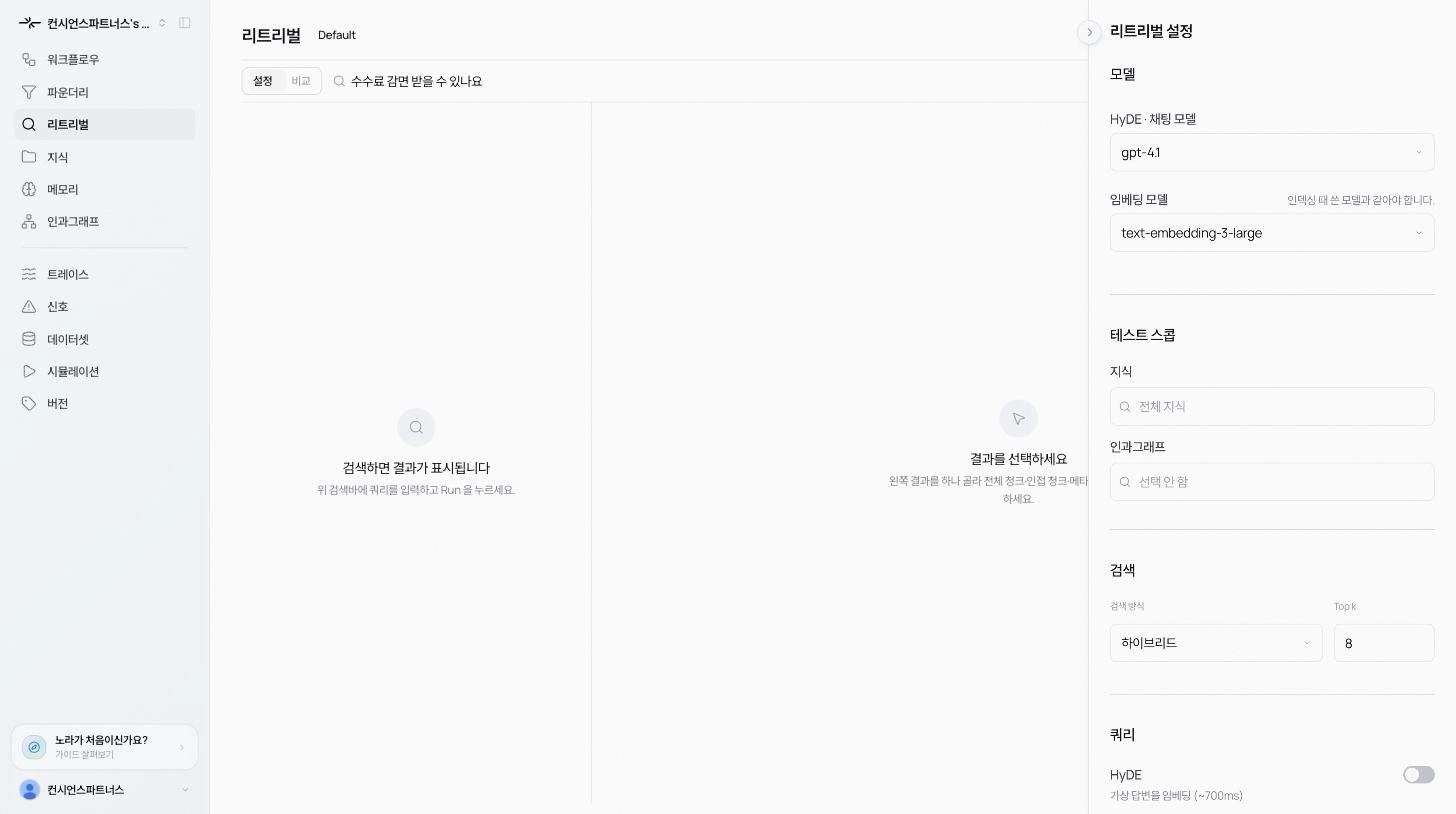
Nora’s retrieval defaults to hybrid search: vector and keyword search run separately and their scores are combined. Consistently higher quality than either alone.
Retrieval settings showing models, test scope, search method, and Top k

The four search methods

Pick under Method in the retrieval settings.
  • Vector: finds chunks that mean similar things, even if worded differently. Good for paraphrased questions, cross-language, conceptual matches. Weak on rare exact terms (SKUs, error codes, proper nouns).
  • Keyword: finds chunks that contain the same literal terms. Good for identifiers, jargon, exact-string lookups. Weak on synonyms and paraphrases.
  • Hybrid (default): runs both and combines the scores. Most real queries need both.
  • KG-rooted: searches starting from the causal graph. See Causal reasoning.

Fusion

Vector and keyword each produce a score. Fusion decides how they combine:
  • Weighted (default): blend the two scores using the weights below. The vector and keyword weight sliders apply directly.
  • RRF: Reciprocal Rank Fusion. Combines by rank instead of raw score. A chunk that’s #3 in both lists ranks higher than one that’s #1 in one and #100 in the other. Robust to score-scale differences.
Tune the weights to your data. Domains where queries come in as natural sentences (customer support, legal Q&A) do better with more vector weight; domains where the target is an exact string (code, part numbers, product names) do better with more keyword weight.

HyDE

A query sentence and a document sentence look different, so embedding the query directly sometimes matches poorly with the chunk that actually holds the answer. With HyDE on, a chat model first drafts a plausible answer to the question. The answer, rather than the question, is then embedded for search. Answer sentences look like document sentences, so the answering chunk surfaces more reliably. The hypothetical answer is thrown away after retrieval. Drafting the hypothetical takes about 700ms, so HyDE is off by default. Pick which model drafts it under HyDE · Chat model.

Embedding model

The embedding model must match the one used at ingest. Different models mean different vector spaces, and similarity becomes meaningless. If your data is multilingual, use a multilingual embedding model and lean the weight toward vector. Vector search bridges languages when meaning matches, while keyword search only matches identical words in the same language.

Testing

The retrieval page itself is the testing tool. Type a query, hit Run, and switch between vector / keyword / hybrid to see how the results shift. Each result carries a similarity score. Narrow with Test scope to search only a specific knowledge folder or causal graph.

When hybrid is overkill

Very small collections (< 1000 chunks) do fine on keyword alone with no extra cost. Very short, keyword-heavy queries (SKU lookups) hit the same recall faster with keyword-only. For those presets, set method to Keyword.