

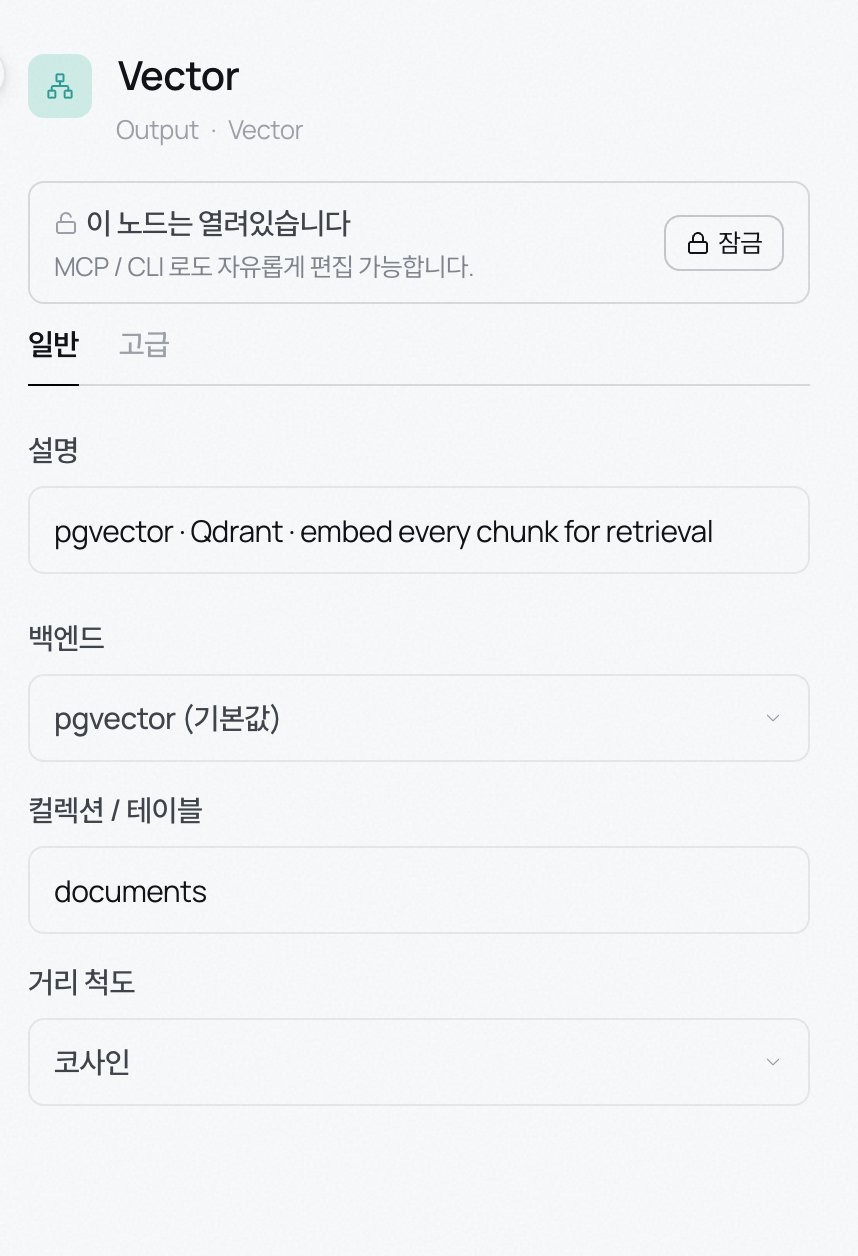
Vector
Writes chunks with their embeddings into a vector index. This is the default destination for most refineries because Agent retrieval reads from here.- Backend: pgvector (default), Qdrant, Milvus, or Weaviate.
- Collection / table: default
documents. - Distance metric: default cosine.
Blob
Preserves the raw bytes as-is. Pair with Vector when you retrieve by vector but cite from the original bytes.- Backend: S3 / compatible, GCS, or Local disk.
- Bucket / path: where to store.
- Encrypt at rest: encrypt on write.
Action
HTTP POST/PUT per record to an external REST API. Use it to deliver results outside Nora, such as to a webhook, Slack, or an internal system.- Endpoint · Headers · Params: same shape as Web / API source, Import from cURL supported.
DB Upsert
Write records into a relational table via an SQL script. The inspector shares the DB picker + SQL editor shell with Source · Database and Enrich · DB Lookup. Write the DML with{paramName} placeholders, and each record’s top-level keys bind to those params in the engine-appropriate order.
- Database: pick an internal resource registered under Settings → Internal resources. The raw DSN never appears in the refinery JSON.
- SQL: write the
INSERT … ON CONFLICT(Postgres) /INSERT … ON DUPLICATE KEY UPDATE(MySQL / MariaDB) statement, or any DML you need. Placeholder-based binding keeps re-runs idempotent when you write a real upsert.
Causal graph
Attaches chunks to the workspace causal graph and stages observed norm hierarchies (e.g. an upper regulation that a lower onedefers_to) as STAGED proposal edges. A person reviews and approves them in the graph editor before they go live. Use this when relationships between documents, such as regulations or insurance policies with amendments, matter to the answer.
Clause lineage
Compares this run’s document clauses against the previous version and proposes a revision history: carried over, amended, new, or removed. The proposals surface in this node’s inspector under the Review tab; a person reviews and applies. Useful for tracking insurance policy revisions. When Clause lineage creates proposals to review, the [Review proposals (N)] button appears to the left of New file in the Knowledge list. See Review proposals in Refine documents for the review filter and approve or reject flow.Splitting destinations
Multiple Output nodes are fine. A common setup combines Vector and Blob, giving you a searchable index next to the raw source for citation. To send different subsets to different destinations, use the upstream node’s inspector Advanced → Flow control →dispatch=routed to branch.